Brion O’Brion and his wives.
Checking out the story behind Brion O’Brion, variously spelt as Brien O’Brien and Bryan O’Brien/O’Bryan, elicited in the first instance, this newspaper advertisement dated 16 October 1819:
“All persons are cautioned against giving Credit on my account to my Wife, Elizabeth O’Bryan, better known by the name Elizabeth McMahon, and lately returned from Newcastle, as I will not be answerable for any debts she may contract.”
Yet another convict transported from Ireland for Life on the ship Atlas (II) arriving in the colony in October 1802, O’Brien’s path seemed to have taken a rather different marital turn to that of his fellow Atlas travellers.
The earliest record after his arrival [1806 Muster] states one Brien O’Brien (Atlas) is employed in Parramatta by a John Steele. Then by 4 September 1808, O’Brien appears on a statement listing that he has been advanced Capital by John Blaxland of 8 pounds 17 shillings. [Blaxland had arrived in Australia the previous year from England having invested 6,000 pounds for free passage for himself, family and servants, guaranteed landholdings of 8,000 acres, and 80 convicts to serve him.]
And then on 17 September 1810, O’Brion married 22 year old Elizabeth McMAHON inSt John’s Church, Parramatta officiated by Reverend Samuel Marsden.
Wife No.1 :
Born in 1788, Elizabeth was sentenced to seven years in Armagh (southwest of Belfast, Northern Ireland), Elizabeth had arrived in the colony on 15 February 1806, one of 36 female convicts on the ship Tellicherry. Some records show only a “Bridget McMahon” on the Tellicherry, but in the General Muster of 1806, it states that one Elizabeth McMahon indeed arrived on that ship and is listed as working on the Government Farm in Parramatta, the first successful farm established in the colony. The site today forms part of Parramatta Park, opposite The Crescent on the northern side of Parramatta River. Other records show Elizabeth had also been despatched to the Parramatta Female Factory.
Now a married man, O’Brien seeks to have his sentence mitigated on 24 March 1812 with an Absolute Pardon granted on 21 February 1813. However, just one month later, his wife’s character surfaces in an event for which she is ultimately indicted on 25 June 1814 viz.:
“Burglariously breaking and entering the dwelling-house of Thomas Fuller house, at Parramatta, on the night or early in the morning of the 26th of March last, and stealing therefrom about 20 yards of calico, value 20s. the sale of which in various fragments was by evidence traced immediately to the prisoner at the bar : She was accordingly found Guilty ; but although the offence was capital in the eye of the Law, yet the Court, from the consideration of the offence being unaccompanied by any of those terrors to the injured persons which rank the crime of burglary among the more direful and abominable species of offences, had thought proper to remit the capital part of the charge ; but finding it necessary at the same time to deter others from similar acts of dishonesty by the force of example, had found her guilty of the stealing, and adjudged that she should stand in the pillory at Parramatta on the 7th of July next, between the hours of 9 and 10 in the forenoon, for one hour, and be kept 5 years to hard labour.”
A mere two weeks later, the Sydney Gazette reports on 9 July 1814 that one “Elizabeth O’Brien escaped from the custody of the gaoler at Parramatta”. It would appear that she is ultimately sent to the newly constructed Newcastle Gaol which was specifically a receiving depot for female convicts. Approximately 1,600 women were sent to the Hunter between 1804 and 1822.
Meanwhile back in Parramatta, while Elizabeth is serving her 5-year sentence, O’Brien continues to advance his holdings from owning 3 horned cattle and 2 hogs, to 5 horned cattle and 2 hogs. (1818-1819). On 16 May 1820, he petitioned for a land grant, which was approved [Deed issued] by Governor Macquarie in March 1821 - 50 acres in Parramatta on which he now kept 12 horned cattle and 1 hog. [ Land and Stock, 1821] and by 1822, states he is a “resident/owner of 50 acres, with 13 horned cattle, 2 hogs and 4 bushels of maize.
At the same time, released back into Parramatta society since 1819, Elizabeth is up to her tricks again with the Court of Criminal Jurisdiction which records that Elizabeth McMahon alias Elizabeth O’Brien, Free, was found guilty of:
“feloniously stealing one iron tea kettle valued at 5 shillings, the good of George Davey (?) of Sydney…to be imprisoned and kept to hard labour for the space of six calendar months from the 27th of December 1822 in “the Factory” [Gaol entrance book]
c. 1778 - 1833
Irish Convict
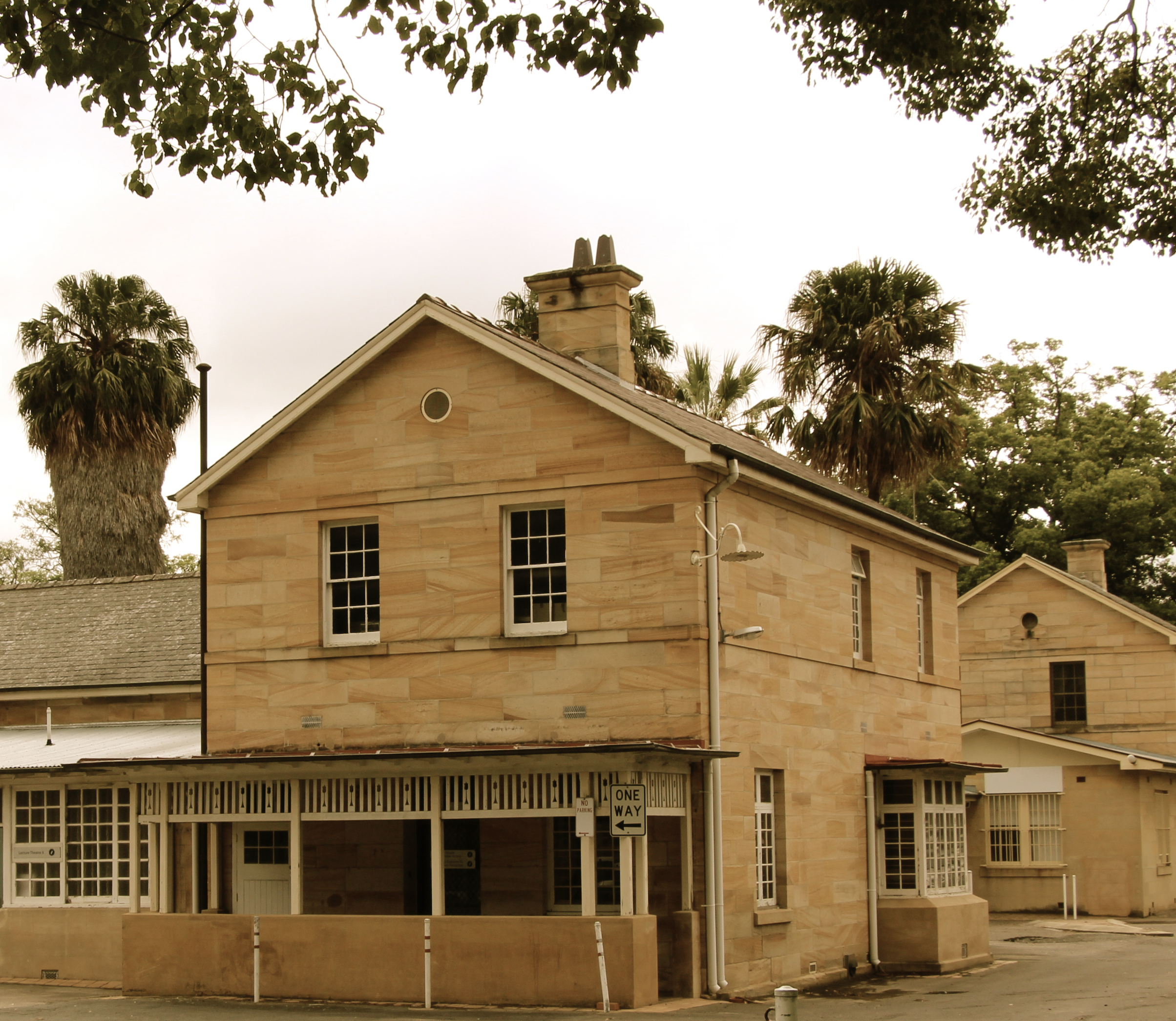
1821 Francis Greenway Building - the Matron's Quarters -Female Factory, Fleet Street, North Parramatta - Photo: Inara Molinari
It would be safe to assume that O’Brien is not living as husband and wife with Elizabeth at this time. Perhaps the increase in his horned cattle might be attributed to a partnering with…
Wife No.2:
The 1828 NSW Census, lists the household of O’Brien - “Bryan” aged 50, with a wife, Mary aged 47, (therefore born around 1781), and no children. A rigorous search of records via ancestry.com.au have narrowed this Mary down to one Mary Bryan.
Convicted on 12 July 1797 at Middlesex, Mary Bryan was transported for 7 years (crime unknown) on the Brittannia (III) which departed Portsmouth, February 17, 1798, with 96 female convicts, and arrived in Sydney 18 July 1798, aged 16 years.
In the 1806 muster, Mary is noted as a housekeeper for Patrick Murphy and by 1814, combined Census documents show that Mary is Free, single and off the Stores. Other than that there is one mention of a Mary Bryan having 4 horned cattle!
Other than the 1828 Muster information, it is difficult to ascertain when O’Brien and Bryan became partners, but on 14 October 1831, Colonial Secretary Papers show a Notice of Intention to Issue a Deed regarding a land grant of 50 acres in Saint John’s Pond, which was finally transferred to O’Brien on 31 August 1833 by Major General Richard Bourke.
As Fate would have it, a mere ten days later, he was dead. What became of his wives is a mystery yet to be solved!
Copyright Inara Molinari, 2026
Documents found via Ancestry.com which include Musters, Census, Colonial Secretary Papers, St. John’s Church, Parramatta Marriage Register, and TROVE.