(1818 - 1847)
Born in Parramatta
John Good Jun.& Family
John Good Jnr’s headstone is the only one remaining, out of a further seven Good family members related to John Jnr. who are recorded as buried in St. Patrick’s Cemetery:
Parents John Good Sen. and Ann Good (nee Chipp)
Brothers Edward Good (referred to in the Morgan II story) and Martin Good, who died aged 21
Daughter Mary Ann Good who died aged 5 years
Niece Mary Ann Good who died aged 12, and nephew John Edward Good who died at the age of 12 (son of Edward and Ann Murphy who later married Morgan II)
John Good’s elder sister Ann Good, firstborn of John Good and Ann Chipp, was the first wife of Morgan Power II. She is also buried in St Patrick’s Cemetery as Ann Power.
A search of Ancestry.com records and TROVE reveals very little about John Good Jnr.
One 1842 record lists him as an eligible juror along with his brother Edward and again in 1843 as farmers living in Seven Hills. At this time, in order to sit on a jury, a man had to have personal wealth exceeding the threshold of 300 pounds. The 1843 record shows Edward Good’s wealth to be c. $2,500 pounds.
Other than this, The Sydney Free Press reported this story on 27 January 1842 which opens up a separate kettle of fish:
“Mr John Good, the younger, of the Seven Hills appeared to answer an information filed against him by one Mary Doolan, of the same district, for being the father of her child, aged four months and with having turned her away without support. The informant admitted that Mr. Good had offered to allow her 5s. a week for two years, but she wished the period to be extended to three years. The defendant said that he had hired the informant as a servant, and that she remained in his service about three weeks, for which he gave her eighteen shillings. A witness was called to prove that the defendant had offered the 5s. The bench considered that Mr Good would be bound to maintain the child, but as to the amount to be paid weekly, the bench said they would take time to consider, until Saturday next, this being quite a novel case before the court.
The outcome or indeed why/how John Jnr. died five years later, aged 29, is unknown.
His father John Good Sen. ( c.1782 – 1854) however, lived to 72 years.
An Irishman, John Sen. was transported for life on the ship Atlas I, arriving in Sydney on 7 July 1802. Whilst his crime is unknown, he was convicted at the time of the 1798 Irish Rebellion. At aged 24 however, he is already listed as a licenced victualler in the 1806 Muster, which indicates that he was not part of the Castle Hill Revolt of 1804.
On 16 February 1807, he married 13-year-old Ann who was born on Norfolk Island in 1793, the daughter of First Fleet arrivals, Thomas Chipp (1754-1842) and Jane Langley (1761-1836). See more information below*
In 1812, John Good Sen. sent a petition to the Governor requesting a mitigation of his life sentence. In this petition he states he has a wife and one child (that is Ann Good who married Morgan Power II) and a Government Servant, one Mr Gowan. He resided on a farm at Seven Hills [Toongabbee district] which he had purchased, and which was under cultivation. This land was near the Power families, and other descendants of Thomas and Jane, so the marriages between the families are not surprising.
Interesting that the Reverend Samuel Marsden vouches for him as he seeks emancipation or mitigation given that John is not shy about stating his Catholic religion. He was granted a conditional pardon on 31 January 1813.
John and Ann’s family continued to grow.
“Evidence suggests there was a private school somewhere in the Toongabbie/Seven Hills area in 1816. Charles Wiltshire, a convict 'upwards of seventy years of age', supported by 13 settlers [one of whom was John Good], who resided 'on or about the Seven Hills,' petitioned Governor Macquarie for permission to teach the local children.” [Dictionary of Sydney]
By 1818, the couple had five children (Ann, Edward, Mary, John Good Jnr. and Eliza) and were granted a further 50 acres in Seven Hills on the recommendation of William Macarthur. Records in March 1821 show that his farm generated 1200 lbs of fresh meat for the Parramatta stores. Sadly, in the ensuing years, they lost a further four children in infancy.
In 1822, records show that a convict was assigned to them (Killeen/Killier) and that John Good was selling wheat to the Stores, an important government food supply. He is also recorded as donating to the Subscription List that was established by Father John Therry to raise funds for building a Catholic church in Parramatta. The grand sum of £109.60s. was raised from the early settler most of whom had been convicts and were now respectable farmers, like John Good, and by the 1841 Census he is clearly noted as Catholic.
With an additional 140 acres granted in 1825, John Sen. is noted as a landholder in the Muster of that year.
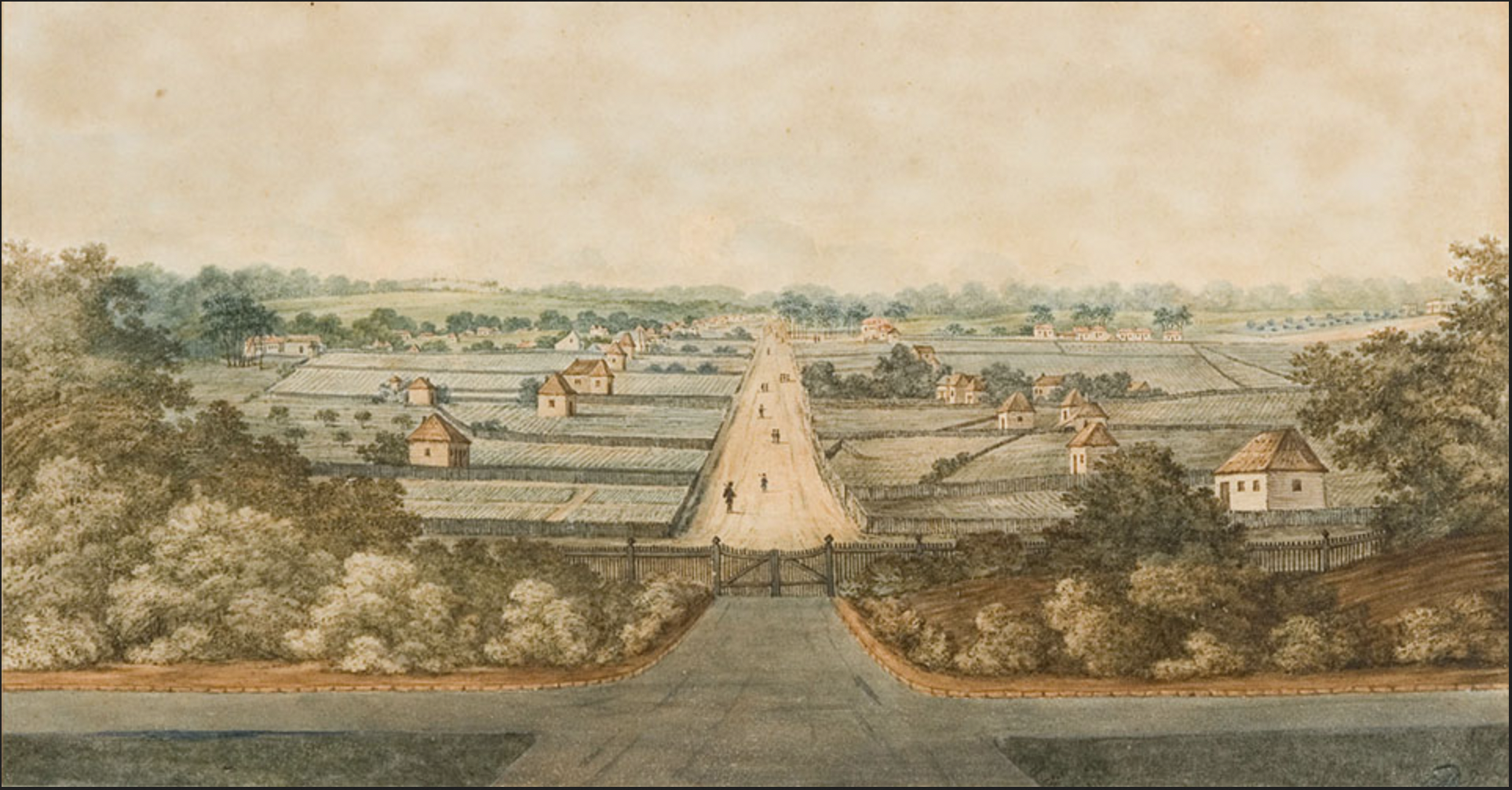
Early settlement of Seven Hills [Dictionary of Sydney]
Then in March 1944, John Good “of the Seven Hills, near Parramatta, farmer” is declared a “New insolvent”. Records of all the hearings and Affidavits by creditors, and proposals for repayment of all debts is available via the NSW State Archives. Interestingly, in relation to his landholdings, specifically 50 acres in Prospect, Good Sen. states that he gifted this to his youngest child, daughter, Mary Ann who at this time was 14 years old and unmarried. He also deposes that he has never been able to read or write.
On his death at aged 72 in John Good Sen. was still described as a farmer. Of his ten children born, only two children outlived him, Catherine (who married William Carroll) and Mary Ann (who married Hartley publican James Caulfield).
* Thomas Chipp was a Private Marine Office attached to the 42nd Plymouth Regiment, who sailed on the Friendship. He was granted land on Norfolk Island where he met Jane, a convict who had arrived on the Lady Penryhn and was later sent to N.I on the ill-fated First Fleet flagship HMS Sirius, that was shipwrecked off the Island’s coast delivering much needed supplies. Thomas and Jane married in 1791 and remained on N.I. until c. 1797. By 1800 Thomas was granted 600 acres in Toongabbie but then went on to serve as a Constable in Sydney from 1811. He died aged 88 (record says 93) and is buried in St. John’s Cemetery, Parramatta. Jane died in 1874 having had eight children (one born on the way to Sydney, Henrietta ) and was buried in the no longer extant Sandhills Cemetery, Devonshire Street.
Author: Inara Molinari, 2026
References:
Numerous source documents originally found through Ancestry.com with further interrogation and substantiation through sources like: TROVE; Parramatta History Centre; “The Parramatta Cemeteries, St Patrick’s”, Judith Dunn OAM; St Patrick’s Cemetery Burial records; historical society records; family anecdotes and research, and a great confirmatory source, “A New Beginning. A story of Three First Fleeters and Descendants”, researched and published by the Jane Langley Descendants Association.