Sgt. Patrick Duffy
Patrick Duffy was a labourer in Sligo Town, County Sligo until he enlisted for “unlimited service” in the 3rd Regiment of Foot (The Buffs) in 1805. Unlimited service means he signed on for life – and it certainly was an active service. After various training camps the regiment set sail for the Portuguese island of Madeira which was in danger of falling into French hands.
After eight months in the capital city of Funchal, the regiment left the island and landed in Lisbon in 1808, defending the harbour for three weeks before marching to Fort St Julian in Lisbon. On the march again, the cohort of The Buffs of which Patrick Duffy was a member, joined Sir John Moore’s army in Spain and took part in the retreat to Corunna, leaving Spain for England in January 1809.
After four months in England, Duffy re joined the rest of the regiment in Portugal being promoted to Corporal with a pay rise from sixpence to tenpence a day. Thereafter Duffy took part in the battles of the Peninsular Wars under the Iron Duke (Wellington) These battles included Douro 1809, Albuera 1811, Vitoria, Pyrenees and Nivelle 1813, and Nive, Orthez and Toulouse 1814. During his service he was wounded twice, shot in the left thigh by a musket ball at Albuera in 1811 and in the right thigh while fighting at Gillette in 1814.
Having achieved seven years of service in 1812 his pay was increased by one penny a day.
By 1812, the war with France being over, the regiment embarked for the American War, landing in Quebec, Canada but the war was all but over. In 1815 Napoleon was again a threat, so the regiment sailed once more to France but missed the Battle of Waterloo.
By 1821 the regiment was under orders as guards on convict ships for New South Wales – 50 men to a ship. Patrick Duffy embarked on Arab in 1822, arriving in NSW in 1823 via Hobart. He moved between Hobart and Sydney until August 1825 during which time he was promoted and demoted several times between Sergeant, Corporal and Private. This was due to being “noisy in his cups” and for “habitual drunkenness”.
The regiment was ordered to Calcutta in 1827 but Duffy was obviously not fit after a long and strenuous service. He changed to the 57th regiment and was discharged in Sydney in 1827, “Worn out by length of service” at the age of forty-two, having served 22 years and 72 days.
The next record of Patrick Duffy is in the Government Gazette 21 July 1828 at Parramatta. ‘Patrick Duffy, Free, to be a constable in the room of John Murphy, deceased.’ He was assigned to Barron Ridge (now Epping).
The details of Patrick’s personal life are sketchy. Wives followed the regiment in those days. He married Bridget in 1810 or 11 and she moved with him through campaigns, promotions, and demotions. Their children were born according to where the regiment took him: William in Spain 1811, Peter possibly in Canada 1814, John possibly born France 1817, Esther 1823 and Patrick 1824 in Hobart, and Elizabeth and Mary Anne, 1830 born in Thornleigh.
Patrick remained in the Parramatta Police until retirement in 1840 when he received a grant of 100 acres and built their slab hut in what is now known as Duffy Avenue, Thornleigh. His discharge papers noted he was a brave soldier, generally of good conduct who had served as a non-commissioned officer in the regiment for 16 years. No mention was made of his promotions and demotions through the ranks due to excessive use of alcohol.
Patrick, Bridget, James, Peter, John and “Easter” Duffy are buried in St Patrick’s Cemetery.
Copyright: Judith Dunn OAM
c. 1786 - 1854
Arrived Free
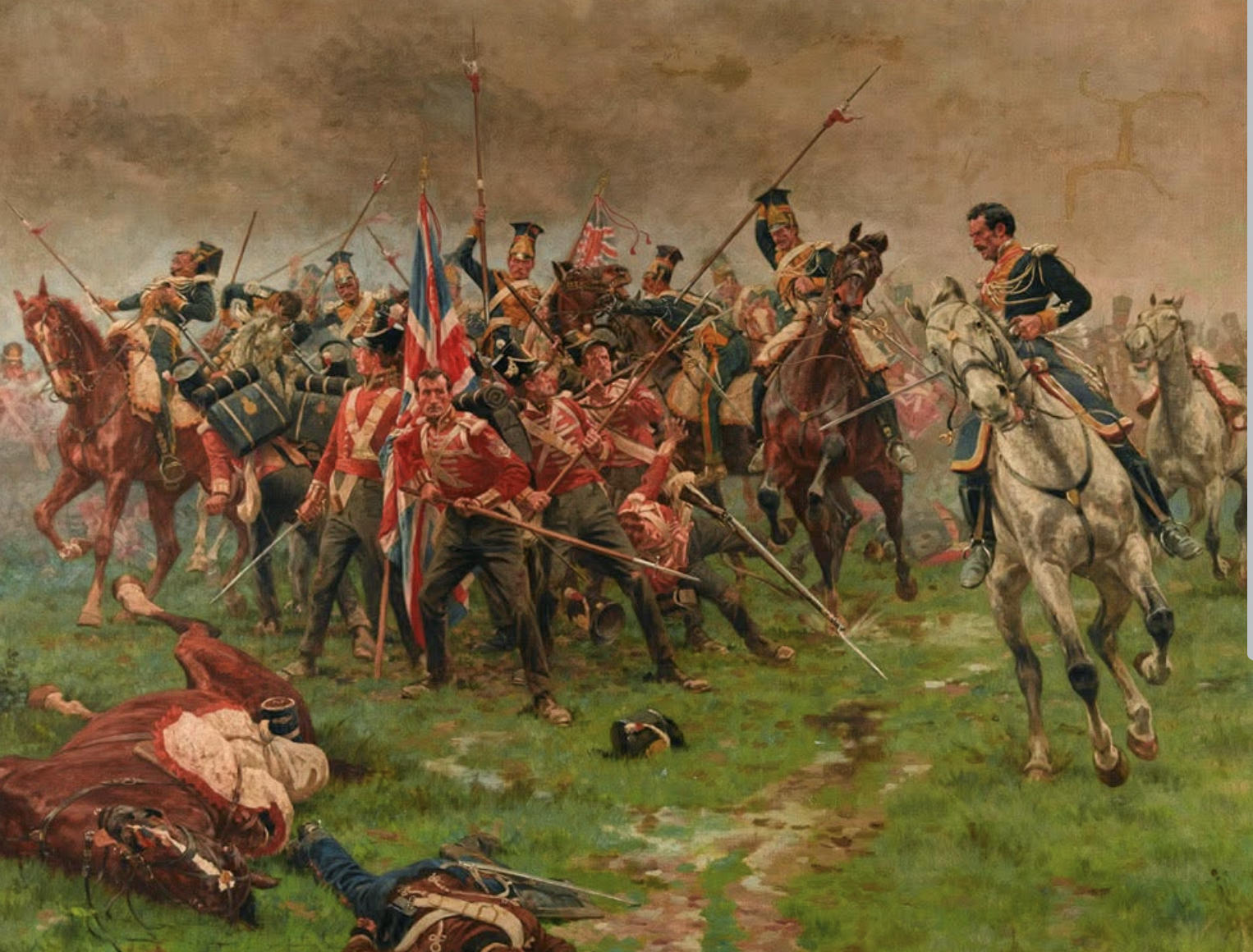
The Buffs at the Battle of Albuera, 16 May 1811