Thomas Nugent
Thomas Nugent’s headstone is significant in laying claim to being the oldest extant memorial in St Patrick’s Cemetery – April 1824.
“Exactly when the first burials took place and by whose authority they were buried on that particular piece of land is unknown” [1.] Some say it was used as early as 1810, but it was not until 1826, when the Rev John Joseph Therry, official R.C. Chaplain of NSW, secured the land specifically for the purpose of a Catholic Cemetery.
Also surviving from this early year are the tombstones of Philip Reily (June 1824)and Thomas McKenna (August 1824).
Thomas Nugent was born in Ireland, a native of Kilkenny. According to Australian Convict Muster Records, the then 15-year-old was tried in August 1799 and sentenced to transportation to Australia for life, for a crime “unknown”.
He departed on the ship Atlas II on 30 May 1802 along with numerous convict rebels and political prisoners, including Nicholas Delaney, Charles Barrington, and John Good (you can read his story). Captained by Thomas Musgrave, the convicts were treated comparatively well with only four deaths en route, arriving in Sydney on 30 October 1802. Thomas was 18 or 19 years old by this stage and was described as a labourer, 5ft 5inches with dark ruddy complexion, dark brown hair and hazel eyes.
There is not much evidence of where Thomas went when he arrived, but in the 1806 Muster, he is noted as being employed by “Warby” in Parramatta, that would be John Warby. It’s worth a quick diversion to read more about Warby as he may well have steered Nugent’s path.
“Warby was transported as a convict for theft, arriving at Sydney in 1792, and four years later, he married convict Sarah Bentley at St John’s Church in Parramatta. Together, they had nine sons and five daughters. After his sentence expired, Warby was given a small land grant at Prospect where he worked hard as a wheat farmer. In 1803 he was appointed stockman of the wild cattle grazing in the Cow Pastures, the site of modern Camden. The path he beat between his farm and the Nepean is still known in parts as Cowpastures Road…Under Governor Bligh, he was appointed a constable, as well as a superintendent of the Cow Pastures region, with full responsibility for the herds.” [2]
It was around this time, that Nugent would have been working for Warby.
The next record we have relates to Nugent’s Pardon which was granted on 31 January 1814, and next a Memorial dated 26 May 1820to Governor Lachlan Macquarie requesting land for a farm, in which he states that he is a constable, has been free for six years, and has performed his duties with “fidelity”.
Nugent would have been serving under Parramatta's well-known Chief Constable, William Sherwin (1763 – 1822). Sherwin had arrived in the colony on the ship Pitt in 1792 as a sergeant with the NSW Corps. He later became a land holder, a storekeeper, a chief constable, and a publican.
The lot of a constable was not an easy one and often attracted an enemy or two! Nugent’s duties would have included chasing runaway convicts (his peers) from local government gangs and the Female Factory; conducting raids on suspected sly-grog dwellings; verifying a convicts’ Tickets-of-Leave; pursuing thefts from the Government Stores and chasing down the goods; executing warrants for domestic and street violence. And the pay was pretty meagre.
In the General Muster of 1822, Nugent is still listed as a Constable in Parramatta, but the Land & Stock Census of the same year also shows that he held 40 acres farming wheat, Maize. Barley, Oats and Beans, with 3 horses, 4 cattle in the “Castle hill” district.
There also appears to be another Land Grant on 30 June 1823 No 3 Allotment East side of Marsden street, Parramatta.
c. 1784 - 1824
Irish Convict
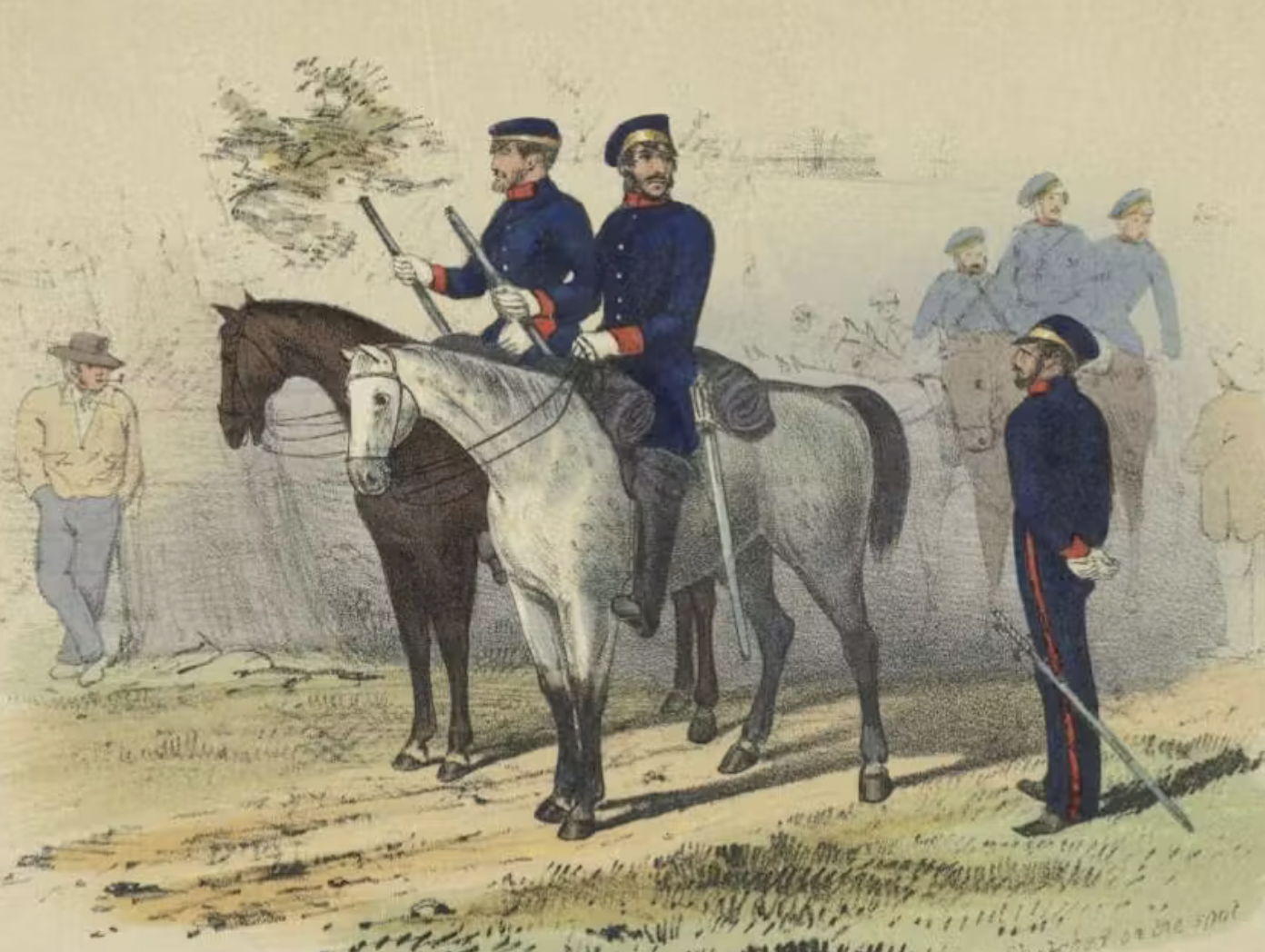
Early mounted police keeping order in the Colony.
In a pay receipt dated 27 December 1823 for work as a Constable–“commensuration in lieu of rations” – there is mention of a wife. A search of available marriage records reveals no details. And then a mere four months later, Thomas Nugent is dead.
On the 20th April 1824, an inquest was held into his death headed up by the Coroner, John Eyre, and jurymen including another St Patrick’s Cemetery local and QR story- John Hodges, and jury foreman Richard Rouse of Rouse Hill fame. The report states:
“on the fifteenth of April [Thomas Nugent] went, in a state of intoxication, to a wake at the Northern Boundary, [ Pennant hills area] in the house of Mary Bowerman, where his conduct was shameful and provoking, in consequence of which he was turned out of doors, but whether he received any violence on that occasion or not, there is no evidence before the jury. He lived four days [after] the night of the fifteenth and had no mark of violence to occasion his death.”
Another interesting diversion: Mary Ann Bowerman (nee Partridge] was born in Parramatta and was married to George Bowerman who had died by hanging in 1820, found guilty, along with his two brothers, Solomon and James, of highway robbery. Constable William Sherwin was in charge of the case and Nugent may well have been involved indirectly with this investigation. George was posthumously exonerated by another condemned convict who claimed he had been working with the brothers. Mary herself died horribly in 1877 by accidental burning at aged 80.
On 5 June 1824 a local notice advises that one John Butcher will take Nugent’s place as a Constable, and the 1825 Muster emphatically notes Nugent as “Dead”.
Copyright Inara Molinari, 2026
[1] Judith Dunn, 1988, The Parramatta Cemeteries: St. Patrick’s Cathedral, p.9
https://convictrecords.com.au/ships/atlas/voyages/872?page=20&arrivals=New%20South%20Wales
Documents found via Ancestry.com and TROVE.