John Hodges
1784-1849
English Convict
On 20th February 1805, John Hodges was sentenced to death for assault, theft and extortion. This was later commuted to transportation for life and he arrived in the colony per Duke of Portland in 1807.
Just one year later, he stowed away on a whaling ship, Sarah, which was headed towards Timor. Unfortunately, within one day’s sail of Timor, he was discovered. Passing another ship headed towards Sydney, the escapee was transferred mid ocean from Sarah to Elizabeth and returned to Sydney.
Hodges settled down and stayed out of trouble, marrying a currency lass (first generation born in the colony), Elizabeth Williams, in St Johns Church in January 1810.
His life’s progress from then on was quite rapid. In July 1813 Hodges received his ticket of leave and in 1814 is listed as being in the service of Edward Shackley, the Government gardener at Parramatta who had also arrived on the Duke of Portland.
In 1814, William Cox was placed in charge of building a road across the mountains to access the newly discovered pastureland. Ever on the lookout to advance himself, Hodges provided a horse and cart to help dispatch supplies for the road gangs in the mountains and in January 1816, probably because of this largesse towards the government, received a Conditional Pardon.
From 1816, Hodges was a very busy dealer in property. In that year he bought the Pig and Whistle Farm at Seven Hills, adding the adjoining 60 acre farm in 1818. By 1821 he held 100 acres of rural land with two horses, 50 head of cattle, eight hogs, five bushels of wheat and 20 of maize.
He dealt in spirits in Parramatta and was granted a publican’s licence in 1818 but forfeited it soon after for keeping a disorderly house[i] and selling sly grog. He held licences over various years but reports by the local constabulary were scathing about his character. “extremely bad and has often been brought forward for keeping a disorderly house and for selling spirits without a licence.”
The whereabouts of the 1818 inn is unknown but by 1821, the building now known as Brislington (a medical and nursing museum), was completed and known as the Hope and Anchor on lot 98 on the corner of George and Marsden streets. Governor Macquarie had declared that a leasehold became freehold if a brick building was erected on the site for the sum of £1,000 which was a great incentive to erect substantial buildings. Local legend has it that Hodges won money at a game of euchre at the Woolpack Inn which assisted with the erection. He immortalised the eight of diamonds winning hand by having convicts create a diamond pattern on the back wall of the building. When Hodges was found guilty of stealing stones from the Government Quarry amongst other misdemeanours in 1825, he was forced to sell the property.
In 1818, records show that John and Elizabeth had a daughter, Mary Ann, and all three are recorded in the 1822 General Muster, however the marriage was not doing well. On 30 September 1820 John had advertised that Elizabeth had “absconded from my house and acted unbecoming as a wife”. No one was to give her credit as he would not settle any debts she contracted after September 1820.
During the 1820s Hodges was supplying wheat and meat to the Government Store and by 1828 had increased his holdings significantly. Property he owned in Parramatta included three cottages besides a substantial seven room house with stockyard and piggery, opposite his town house. He also dabbled in horse breeding, advertising which horses would stand at stud at the Anchor and Hope, mainly a well-bred horse, Young Hector, whose sire, Hector, was owned by Darcy Wentworth.[ii]
The 1828 Muster shows John living with his 10-year-old daughter and three servants. In the same muster, Elizabeth, still recorded as “Wife of John Hodges” aged 31, is living in Seven Hills, employed as a servant of Simon Moulds.
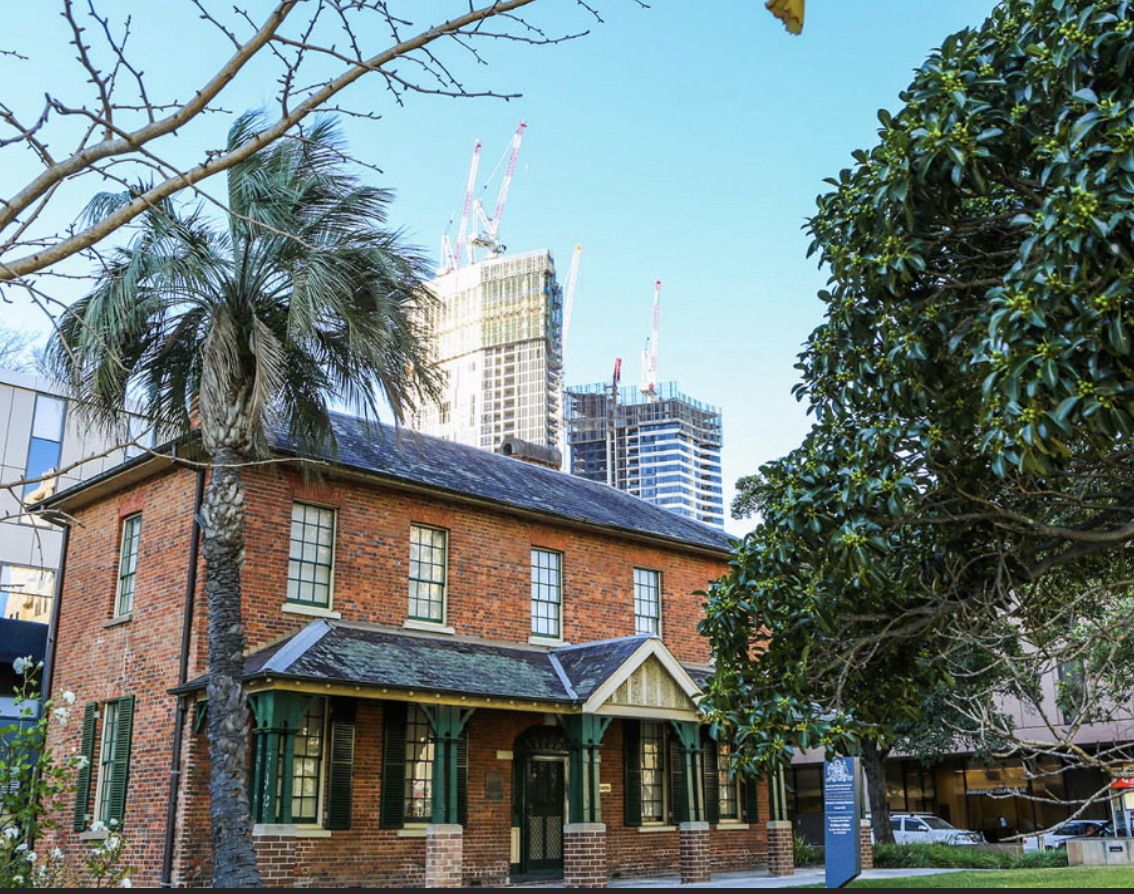
Brislington Medical and Nursing Museum, Parramatta
This is the picture of a man doing very well indeed but he continued to live on the edge of respectability. In giving evidence at the Bigge enquiry[iii], Reverend Samuel Marsden said about Hodges. “I know a man named Hodges I always thought him and still think him a bad character. He kept a regular brothel near my house at Parramatta……. He was frequently brought before the magistrates for receiving stolen goods from gentlemen’s servants and for receiving women from the Factory to meet them and for keeping a drunken and disorderly house.”
Hodges continued dealing but in 1844 he served twelve months gaol for stealing flagstones from the mortuary of the hospital next door to pave the inn yard. He also reputedly stole window frames and nails. His property was sold for £3,000 including “the goods, chattels, merchandise, debts, credits, and all other personal property.” The purchaser was John Ryan who allowed Hodges to live in the house until his death on 14 June 1849.
Was this the same John Ryan who was, at this time, Inspector of Distilleries? If so, he would have known Hodges well from past dealings at the inn and sly grog dealing. Did he allow Hodges to live in the inn as a gesture of kindness to a fellow Catholic? It is unknown exactly when Hodges became a Catholic. All early records record him as protestant but it was expedient at that time to be protestant in a Church of England colony, particularly in business dealings. Hodges is buried in an impressive vault in St Patrick’s Cemetery close to the mortuary chapel and not far from the grave of John Ryan.
[i] Disorderly house, meaning a brothel
[ii][ii] Dr Darcy Wentworth of Wentworthville
[iii] The Bigge Report was an enquiry into the conduct of the Colony
Copyright Judith Dunn OAM.