John Stanton
c.1786 - 1861
English convict, Italian by birth
The beautifully executed memorial in St Patrick’s Cemetery for John and Mary Stanton set the author on a long and complicated journey in search of their story, as no one of the name John Stanton is recorded entering Australia around the time he was active in the colony.
Who would guess he arrived as Stephano Haskett, also known as Stephano Powseitch? From arrival until his death in 1861 he was recorded in various documents as:
Haskett – Haskitt - Askett – Awich – Powitz – Posich – Powseitch - Pozetch – Posick – Powsett - Osteith and finally Stanton.
The key to this puzzle lay with his wife, when it was discovered, he had adopted her surname, no doubt frustrated at the various miss-spellings of his original name.
Incredibly, Mary Stanton also had another name. Mary was convicted in County Mayo for having forged banknotes in her possession and embarked from Cork for Australia, arriving per Elizabeth for a fourteen-year sentence in November 1818. The ship’s muster noted Mary Stanton, no education, alias Reilly. On arrival she was ordered to Parramatta by water, undoubtedly to the Female Factory for assignment.
In 1819 she received permission to marry John Posich, the ceremony taking place on 27th March 1820 at St Johns Church, Parramatta. The couple subsequently had six children, Margaret, John, Mary Anne, Hannah, William and Bridget. Mary died in childbirth bearing Bridget but incredibly for the times, baby Bridget survived.
In the 1828 census the family is listed as Stephano Haskitt, Ticket of leave, (akin to parole today) Catholic labourer of Castle Hill aged 46 with approximately three acres of land and 15 cattle. Included in the census are his wife Mary, 30 years, described as a government servant (convict) four children and three convict males to help with the land.
When their fifth child, William, was born in 1829, he was baptised at St Mary’s Cathedral. On the same day John and Mary were remarried in the Catholic Church. Many Catholics married in the Church of England as Reverend Samuel Marsden, Chief Cleric of the colony, said anyone not married in the Church of England were just concubines and not considered married at all. The couples would later go to their own church and marry again within the rights of that denomination. Despite their earlier marriage in the Church of England they had always considered themselves Catholic as the whole family declared they were Catholics on the 1828 census form.
John and Mary both signed the marriage papers with their X mark, revealing neither could read or write. This explains the many spellings of his name. As he could not spell it himself, the authorities wrote down what they thought they heard. Speaking with an accent would have exacerbated the problem.
On 20 June 1836, Stephano Haskett received a conditional pardon. His place of birth on the document is shown as Palermo, Italy in 1782, another clue to his story.
Working backwards through shipping lists from his 1820 marriage to find an Italian entering the colony proved fruitful. Two Italian convicts, Piedro Poloni and Stephano Haskitt, also known as Stephano Powseitch, arrived per Earl Spencer in 1813. Haskitt, 27 years old, had been convicted of larceny at the Old Bailey in 1812 and sentenced to death, later commuted to transportation for life. In company with Juan Perusino, he stole a watch, chain and seals, the goods of Salvatore George from the dwelling house of Antonio Sposito. The names reveal an enclave of Italians, living in England. Stephano was listed as a sailor.
John Posich (also listed as J Possage) was sent to Coal River (Newcastle) for one year in 1815, which indicates he may have been in some trouble in the colony as that was a place where recidivist convicts were sent. A former servant of Reverend Robert Cartwright, a letter was sent regarding a remission of the sentence of J Pozetch. In 1816 John Powitz returned to Sydney.
It is unknown how he met Mary Stanton but it must have been with some relief that he adopted his wife’s name on marriage and from then on became John Stanton. Mary also seems to have been in trouble in the colony as when she gave birth to her third child, Mary Ann Stanton, her residence was listed as the Female Factory Parramatta (Convict Women’s Gaol)
Mary died in childbirth in 1830 and was buried in St Patrick’s Cemetery. John lived to the age of 80 years, dying of old age at South Colah, in August 1861.
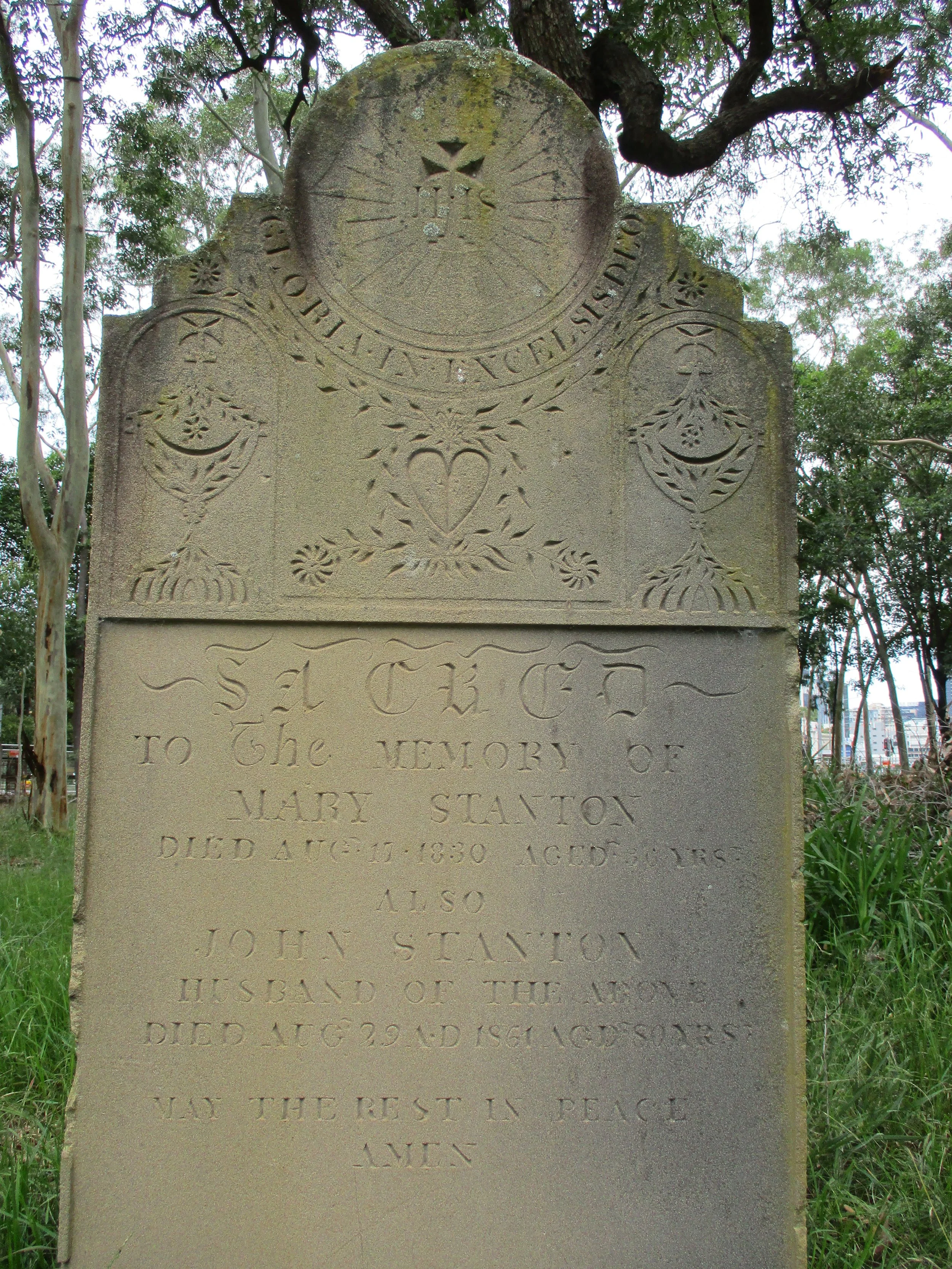
Stanton headstone in St. Patrick’s Cemetery
The remarkable memorial that sparked this research is one of only three known in this particular design. Unfortunately, it is not signed so the skilled artisan is unknown. One memorial is for John and Mary Stanton, one for Easter Duffy (yes Easter, not Esther). John Stanton Jnr married Elizabeth Duffy so the stones are linked by family. The third stone is for Anthony McBride who has not been linked to the family tree to date.
Incised, rather than carved in relief, the memorials have many Catholic symbols. In a circular section at the top is a cross standing on the steps of faith and hope. IHS* is inscribed across the arms of the cross, the whole enclosed within rays, as from a monstrance. The Latin inscription immediately below is Gloria in Excelsis Deo, Glory to God in the highest. Central to the stone a heart, with leafy tendrils and flowers coming from the top, may represent the Sacred Heart. This is reinforced by Easter Duffy’s memorial which has a cross rising out of the heart. On all three stones the heart is flanked by ciboria* (chalices with lids) with leafy tendrils and flowers filling in the spaces between. Beautifully inscribed, the memorials to the Stanton, Duffy and McBride families clearly and proudly display their Catholic faith.
Copyright Judith Dunn OAM
References: Pioneers of Hornsby Shire, Church registers, Shipping lists, T Nutland (descendant)
*IHS or IHC are monograms or symbols for the name Jesus – a contraction of the Greek work for Jesus, translated into the Latin alphabet as Iesus or Jesus
*Ciborium – medieval Latin for a drinking cup. Ciboria is the plural form. Within the church these are chalices with an arched lid, usually surmounted by a cross.