Philip Hogan
1766 -1829
Irish Convict
Philip Hogan was a political prisoner from Clonmel, County Tipperary, Ireland. He was a member of the United Irishmen and was transported for life for political offences against English rule.
An educated man, he arrived in February 1800 on Friendship the same ship that carried Father Dixon to the colony*. He married Mary McMahon on 26 March 1810 in St John’s Church by Reverend Samuel Marsden. The couple went on to have eight children, and 59 grandchildren by the time he died on 23 May 1829 aged 63.
The 1824 census reveals he was on 180 acres of land at South Creek with 17 acres in wheat, 1 ½ in potatoes with another 40 acres cleared. He owned 110 horned cattle, 23 hogs, 17 bushels of wheat and 5 bushels of maize. This is a convict who worked hard and did remarkably well in the colony.
Phillip was an assigned servant to Reverend Samuel Marsden at his farm, Mamre at St Marys, and continued to live there for some time after he gained his freedom.
His curious epitaph reads,
“How lovd how valud once avails thee not
To whom related or by whom begot
A heap of duft alone remains of thee
Tis all thou art and all the proud shall be.
This verse is taken from Alexander Pope’s “Elegy to a Dear Departed Lady.”
Copyright Judith Dunn OAM
*Other notable passengers (mostly political prisoners) on this vessel who might have strong ties to the Parramatta region and possibly either themselves or their descendants are buried in St. Patrick’s Cemetery:
John Delaney, Thomas Flynn, John Connor, Michael Kennedy
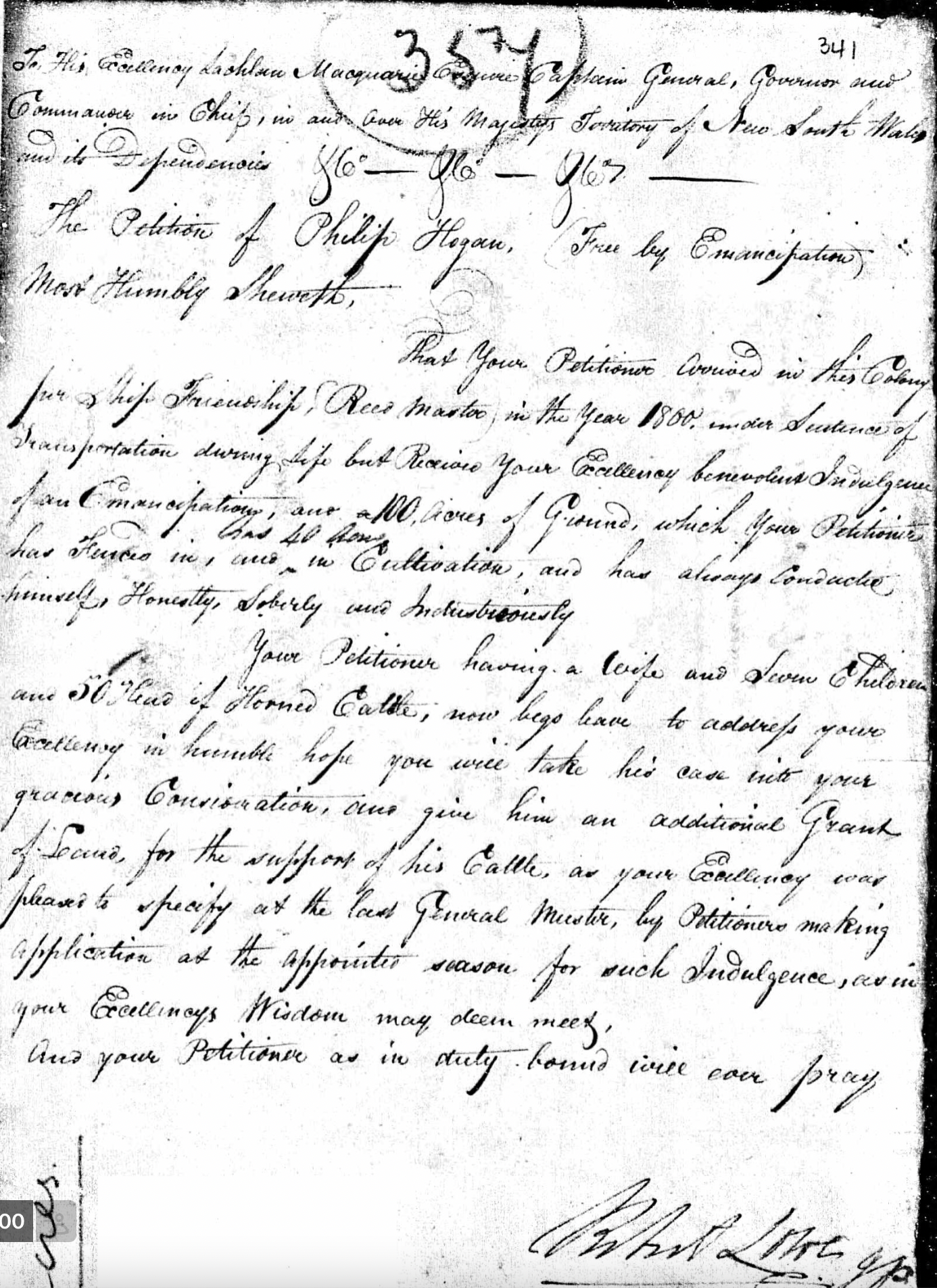
Petition to Governor Lachlan Macquarie to be granted additional land.