1788 - 1840
Wife of Vincenzo Rafael Estacio Chiodetti, reputably Australia’s first Italian Band Master
Maria Chiodetti
Vincenzo Chiodetti
Local historian Judith Dunn OAM was intrigued when transcribing headstones in St Patrick’s Cemetery to discover the following epitaph written in Italian:
Maria Chiodetti, Native Detti Citta I Roma
Nata I Amio 1788 Finea Su-A
Vita Li 6th Aprile 1840 in Questa Citta
Moglie of Vincenzo Chiodetti Band
Maestro Del Reggimento 28 Fanteria.
The languages department of the University of Armidale translated it as: Maria Chiodetti, Native of the City of Rome, born in the year 1788 in this City, died 6 April 1840 in this city [meaning Parramatta], wife of Vincenzo Chiodetti, Bandmaster of the 28th Infantry Regiment.
Vincenzo Rafael Estacio Chiodetti was born in Rome in 1788 and married Maria in 1810. At the time his calling was a trombone player. Their son Alexander Antonio Mario Domenic Chiodetti was born on 21 February 1811.
On 19 January 1836 the Sydney Gazette reported, “the ship John Barry, Captain Robson with 318 male prisoners under the superintendence of Dr McTernan R.N. The guard and passengers consist of Lieutenant Colonel French, Lieutenant McDonnell and Ensign Smart of His Majesty’s 28th Regiment, Mr Cheodille, Bandmaster, Mrs Cheodille and 30 rank and file of the 28th Regiment, seven women and three children.”
Newspapers were quick to praise “Mr Chiodile, the first Italian band master this colony ever possessed. His band plays with more strength and pith than any other I have ever heard in this place..... They all look stout and well and are therefore able to blow with pith into their instruments.”[1]
Their son Alexander does not appear in records of Australia. He was married in Rome and between 1838 and 1874 produced 19 children, dying in “Mussorie” India in 1896.
Vincenzo seemed to have had an excitable and passionate nature. In 1839 a large advertisement appeared in a Sydney newspaper [2] protesting that a music master in Sydney had ridiculed Chiodetti in front of one of his scholars. It reads in part:
“Mr Chiodetti is very sorry any Gentleman professing the Sciences of Music should so far forget himself as to ridicule one with whom he is not acquainted and consequently cannot be a judge of his abilities as a Master of Music....”
The article points out errors in the Gentleman’s music, stating his musical education appears rather imperfect. The matter could be settled if the person in question came to Parramatta for a musical challenge. If he did not come, Chiodetti threatened to reveal his name publicly.
The band master settled into life with the regiment in Parramatta but sadly his wife Maria died in April 1840 at the age of 50 years and was buried in a vault in St Patrick’s Cemetery.
A newspaper article 7 July 1840 [3] reveals Mr and Mrs Chiodetti each donated £2 10s as subscriptions for the erection of St Patrick’s Church, Sydney. As Maria had died in April 1840 it was thought the money had been donated in her memory, until a marriage was discovered between Vincenzo Chiodetti and Ellen McCabe at St Patrick’s Church Parramatta on 20 May 1840, just 6 weeks after the death of Maria. Father Michel Brennan officiated.
In 1841 Chiodetti’s band was praised when the celebrated composer, Nathan arrived in the colony but with the strict note that all vocals should be in English. “Let us have English then, in all vocal pieces – and banish Italian till it can be fairly and generally understood”[4]
When the band embarked for Bombay in June 1842, Chiodetti was not with them as he feared his constitution was not strong enough for India. He had been their bandmaster for 14 years and they presented Signore Chiodetti with a certificate of character and musical proficiency as Professor of Music, stamped with the regimental seal. Another reason they may not have wanted to sail was the imminent birth of Maria Sancta Fortunata Chiodetti which occurred on 22 June 1842.
The family resettled in High Street, West Maitland where Chiodetti advertised to teach Pianoforte, Guitar and Violin as well as tuning pianos and importing real Roman violin strings.[5]
Moving once more, this time to Windsor, Chiodetti’s proficiency in teaching pianoforte was called into question by a Mrs Hadsley. Again this was refuted in a voluble advertisement[6] denigrating Mrs Hadsley and offering to discuss the issue in public academy at Sydney.
Moving back to Parramatta, Ellen Chiodetti was granted land in Marsden Street. Vincenzo could not own land at this time as he was considered an alien. When Ellen died in November 1852, Vincenzo married again just six weeks later in January 1853. The marriage to Anne Winter was held at St Patrick’s Church Parramatta officiated by Father Nicholas Joseph Coffey.
Chiodetti applied to be naturalised on 27 June 1853, “being possessed of real property and anxious to obtain legal title to it.” This would be the land granted to Ellen. He was listed In Naturalised Aliens Returns on 5 October 1858 and died on 5 December in the same year. Buried in St Patrick’s Cemetery, Anne, his executrix did not add his name to the family vault. In early May 1859, seventeen year old Maria ran away from her step mother who put an advertisement in the newspaper:
I hereby CAUTION the public
Against giving any credit to MARY CHIODETTI
As she has left her home against my consent
ANNE CHIODETTI Parramatta 16 May 1859[7]
Maybe Maria inherited her father’s passionate nature. She married Charles Weedon in 1860 at the age of 18 years.
Reminiscences in the Town and Country Journal stated Signor Chiodetti had taught the very best families and for the encouragement of pupils, held musical parties while the lower tastes were provided for at Morris’s cockpit and by sparring, dogfights and free and easy clubs. Chiodetti must have been a great asset to the more genteel pursuits of the colony.
Copyright Judith Dunn OAM
1788 - 1858
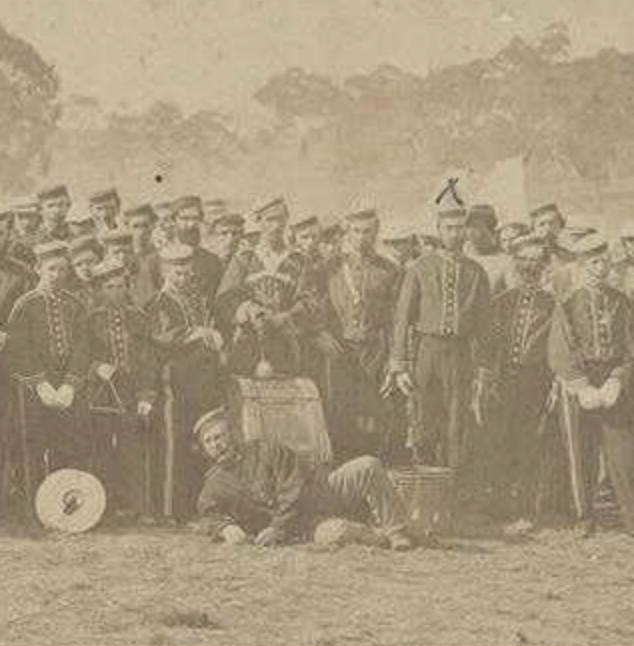
Vincenzo Chiodotti (lying down) with his band. Credit to: Errol Seymour who shared via Ancestry.com.au on 7 March 2021
[1] Sydney Gazette 2 February 1836
[2] Sydney Herald 13 February 1839
[3] Australasian Chronicle 7 July 1840
[4] Sydney Herald 22 February 1841
[5] Australasian Chronicle 7 April 1842
[6] Weekly Register of Politics, Facts and General literature 13 January 1844 repeated 20-1-1844 & 7-2-1844
[7] Sydney Morning Herald 18 May 1859